

Segmenting Your Audience for Better WhatsApp Campaigns
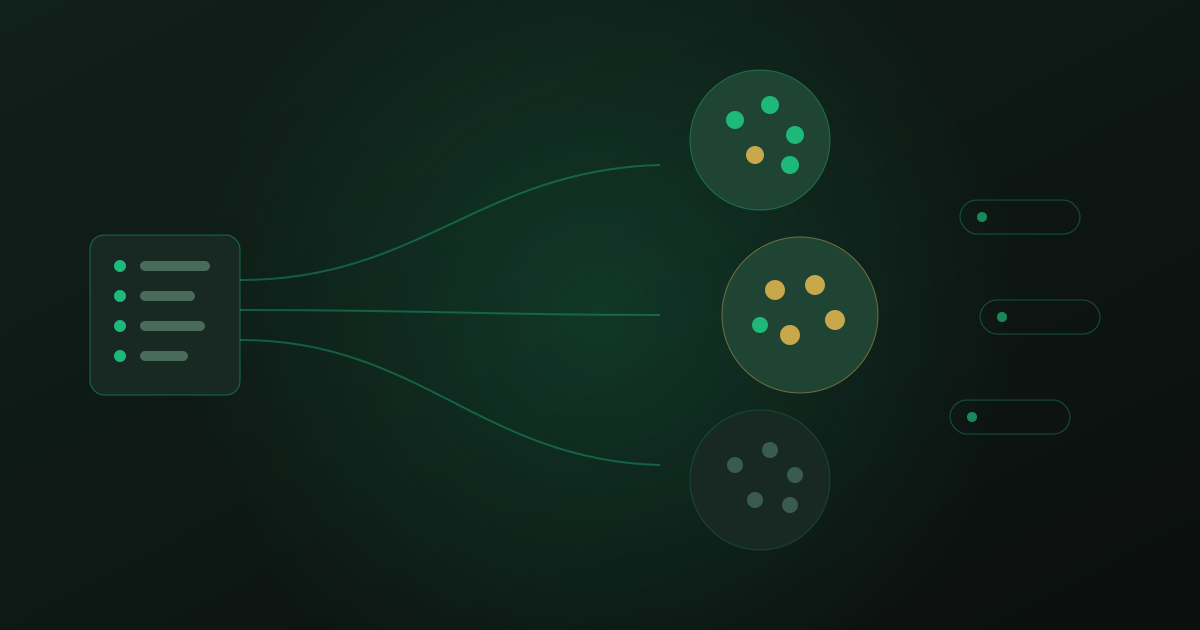
Send the same broadcast to your entire contact list, and you get the same result every time: a lower read rate than you hoped for, a few opt-outs, and one or two customers who reply asking why you're advertising a service they already bought last month. Blasting everyone treats a loyal repeat client the same as someone who inquired once, eighteen months ago, and never replied. WhatsApp punishes that mismatch — as our In-Depth Guide to WhatsApp Marketing Campaigns explains, relevance is what keeps your quality rating healthy, and relevance starts with knowing who you're actually talking to.
Segmentation sounds like an enterprise marketing term, but for a service business it is a simple idea: split your contact list into groups that deserve a different message, then write that message. You do not need twenty segments. Four or five, built around real differences in intent, will outperform any one-size-fits-all campaign you have ever sent.
The segments worth building first
Before you touch your campaign tool, look at what you already know about each contact. Four groupings cover most of the value for a typical service business:
- Past customers — people who have already paid you once. They convert fastest and need the least convincing, so they deserve offers, not explanations.
- Cold leads — people who inquired but never booked. They need a reason to reconsider, not a repeat of the pitch that didn't land the first time.
- VIPs — your highest-spend or most frequent customers. They notice being treated like everyone else, and they also forgive a slightly more direct ask.
- By service or location — a customer who booked a haircut is not a lead for your nail service, and a customer in one branch's catchment area does not care about another branch's opening hours.
Building segments from CRM tags and fields
Segments only work if the data behind them is accurate, which means the real work happens before the campaign, inside your CRM. Every completed booking, every service type, every branch, and every date of last contact should land in a field or a tag automatically — not get entered by hand once a quarter. If your CRM already tracks bookings and conversations in one place, most of this segmentation falls out of data you are already collecting; if it doesn't, that gap is worth fixing before your next campaign, not after it underperforms.
A useful habit is to tag contacts the moment their status changes, rather than batch-tagging later. A customer who goes three months without a booking is a candidate for the re-engagement campaigns that win back cold contacts we cover elsewhere — but only if your CRM actually flags them as cold in the first place. Segmentation and re-engagement are really the same discipline, just applied at different points in the relationship.
Matching tone and offer to each segment
Once the groups exist, resist the urge to write one message and swap in a name. Past customers respond to a direct, confident tone and a next-step offer — "time for your next service? Here's 10% off if you book this week." Cold leads need warmth and a lower-commitment ask, something closer to "still looking for X? Here's what changed since we last spoke." VIPs expect to be recognized specifically, even briefly — a message that opens by referencing their history reads as attentive, not automated.
A segment is not a label in your CRM. It's a promise that this message was actually written for the person reading it.
— Convelly team
Where over-segmentation quietly backfires
It is possible to take this too far. Once you are combining service type, location, spend tier, and recency into a dozen micro-segments, campaigns take hours to prepare and each one reaches too few people to justify the effort. Most teams find that four to six segments cover 90% of the value, and the remaining edge cases are better handled with a one-off manual message than a permanent segment. If a segment has fewer than a few dozen contacts, ask whether it is really a segment or just an exception.
The only way to know whether your segmentation is actually working is to look at the numbers by group, not just the campaign average — read rate for VIPs versus cold leads will usually look nothing alike, and that gap tells you where to adjust next. Our breakdown of measuring WhatsApp campaign performance and the metrics that matter covers exactly which numbers to track per segment, and how to read them.
A 20-minute walkthrough of how Convelly runs compliant, segmented WhatsApp campaigns end to end.
Book a Demo